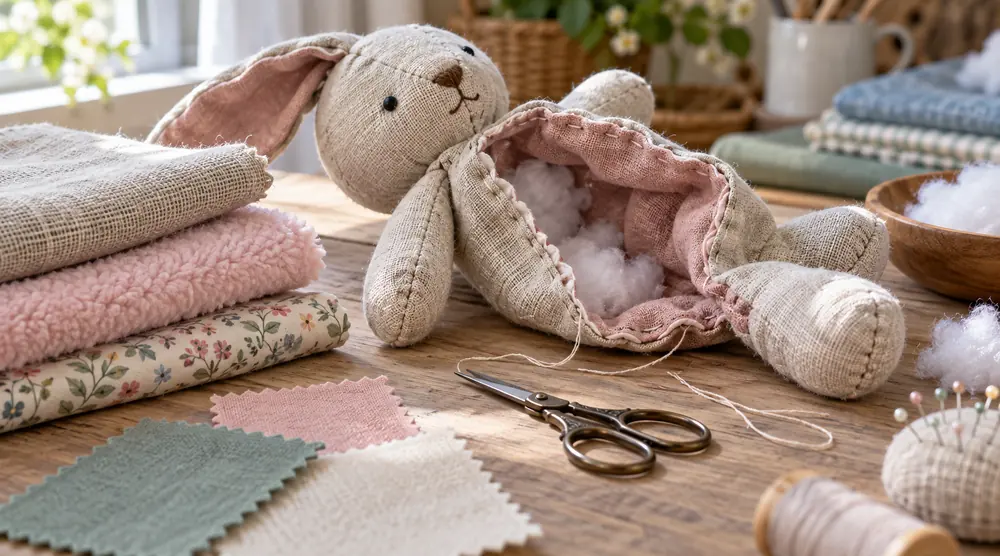
When sewing a handmade softie, the fabric selection dictates not only how the toy looks on the craft table, but how it survives three years of friction, saliva, and machine laundering. Beginners often select textiles based purely on colour or surface softness. However, structural integrity depends on fiber mechanics: how a weave or knit reacts to internal pressure, abrasion, and moisture.
Understanding how different textiles behave under stress allows you to pair the right fabric with the right toy design, ensuring your creation remains cuddly and intact rather than fraying at the seams after its first turn in the washing machine.
Woven Cottons: Predictability and Preparation
Medium-weight woven cotton—such as quilting cotton or light linen-cotton blends—is one of the most accessible textiles for plush construction. Woven fabrics consist of warp and weft threads intersecting at right angles, providing high dimensional stability along the grainline.
Dimensional Stability and Shrinkage
Unwashed cotton fibers absorb water and contract during laundering. Standard quilting cotton can shrink between 3% and 5% on its first hot wash. If you stuff an unwashed cotton toy and subsequently submerge it in water, the outer shell will contract around the non-shrinking synthetic fiberfill, causing unsightly pucker lines along every seam line.
- Mandatory Pre-Washing: Always pre-wash woven cottons in warm water and dry them completely before cutting pattern pieces.
- Grainline Precision: Woven cotton has zero mechanical stretch along the straight grain, minimal stretch along the crossgrain, and maximum diagonal flexibility along the bias. Placing pattern pieces accurately along the grainline prevents asymmetrical warping when the toy is stuffed tight.
- Fraying Vulnerability: Woven edges unravel when subjected to internal tension. Seam allowances on cotton softies must never be trimmed closer than 6 mm (1/4 inch) unless reinforced with stay-stitching or seam sealant.
Because woven cotton lacks inherent stretch, it reveals any imperfection in your stitching curve. Tight curves require careful clipping, a technique covered in our guide on sewing and turning clean curves.
Microfiber Plush: Minky and Polyester Fleece
Synthetic plush textiles such as polyester fleece and minky (plush knit fabric with a raised pile) have become industry standards for commercial and handmade soft toys. Made from extruded polyester microfibers, these fabrics offer extreme softness combined with remarkable tear strength.
The Mechanics of Minky
Minky is constructed on a knit backing with a directional fur surface known as the nap. Unlike woven cotton, minky possesses two-way or four-way mechanical stretch depending on the knit structure.
- Directional Nap Alignment: When laying out pattern pieces on minky, every piece must be oriented so the pile smooths downwards toward the base of the toy. Cutting one ear with the nap running upward and the other downward creates an obvious shade difference due to light reflection.
- Knit Backing Stretch: The elasticity of minky allows stuffed shapes to expand into smooth, rounded volumes. However, under firm stuffing pressure, minky will stretch beyond the intended pattern boundaries. To maintain precise structural shapes (such as flat foot soles or narrow animal snouts), back the minky with lightweight non-stretch fusible interfacing before stitching.
- Zero Laundering Shrinkage: Polyester microfibers do not absorb water in the manner of plant fibers. Minky does not shrink during washing. However, high heat in a tumble dryer will melt the fine plastic filaments, permanently ruining the soft texture and causing synthetic pilling.
Polyester Fleece Considerations
Polyester anti-pill fleece offers substantial body and low stretch, making it an excellent choice for beginner sewists. It does not fray when cut, meaning raw seam edges inside the toy will not unravel under tension. However, low-grade fleeces develop small rough balls (pills) on high-friction areas like limbs and snouts after repeated handling. Always select premium anti-pill fleece with a tight knit base.
Felt: Wool vs Acrylic Performance
Felt is a non-woven fabric produced by matting, condensing, and pressing fibers together. It is widely used for appliqué details, animal ears, and small stuffed figures. However, the performance difference between 100% wool felt, wool-rayon blends, and 100% synthetic acrylic felt is vast.
| Fiber Composition | Tensile Tear Strength | Washability & Water Reaction | Pilling & Surface Wear | Safety for Infants |
|---|---|---|---|---|
| 100% Wool Felt | High fiber interlocking; resists tearing under seam strain | Felts further and shrinks in hot water; dry clean or cold hand wash | Low pilling; smooths down with light friction | Excellent; natural, non-toxic, saliva resistant |
| Wool / Rayon Blend (35/65) | Moderate strength; good flexibility for small details | Minimal shrinkage in cool water; retains shape | Moderate wear resistance over time | Very good; soft hand-feel for sensory toys |
| 100% Acrylic Craft Felt | Very low strength; seams pull apart under light tension | Resists water but fibers stretch out of shape permanently | Severe pilling after minimal handling | Poor; thin fibers shed easily, posing ingestion risks |
Why Acrylic Craft Felt Fails
Inexpensive acrylic craft felt sold in craft stores consists of loosely punched synthetic fibers. When sewn into a seam under internal stuffing pressure, the needle holes tear open like a perforated sheet of paper. For any toy intended for actual handling by a child, acrylic felt should be completely avoided.
Use 100% wool felt or a high-density wool-rayon blend for facial appliqué, pads, and ears. When stitching felt pieces onto a softie shell, use a dense blanket stitch or small whipstitch with embroidery floss, ensuring the needle pierces at least 3 mm inward from the raw edge.
Matching Fabric Pairs to Seam Engineering
Combining different textiles—such as a woven cotton tummy patch on a minky bear—requires careful seam management. Because the two fabrics react differently under needle penetration and feed-dog tension, the stretchy minky will tend to creep forward while the stable cotton stays stationary.
To prevent misaligned seams and distorted bodies when joining dissimilar fabrics:
- Pin or clip seams every 15 mm along the seam line.
- Place the stretchy plush fabric on the bottom against the sewing machine feed dogs, allowing the machine teeth to pull the pile evenly while guiding the stable cotton on top.
- Adjust your stitch density to support the weakest fabric in the pair, as detailed in our guide to seam strength and stitch density.
By selecting fabrics based on their physical fiber behavior rather than surface appearance alone, you build toys that withstand washing cycles, retain their intended geometry, and provide safe play for years to come.