Patterns The notebook
A hedgehog pincushion from fabric scraps
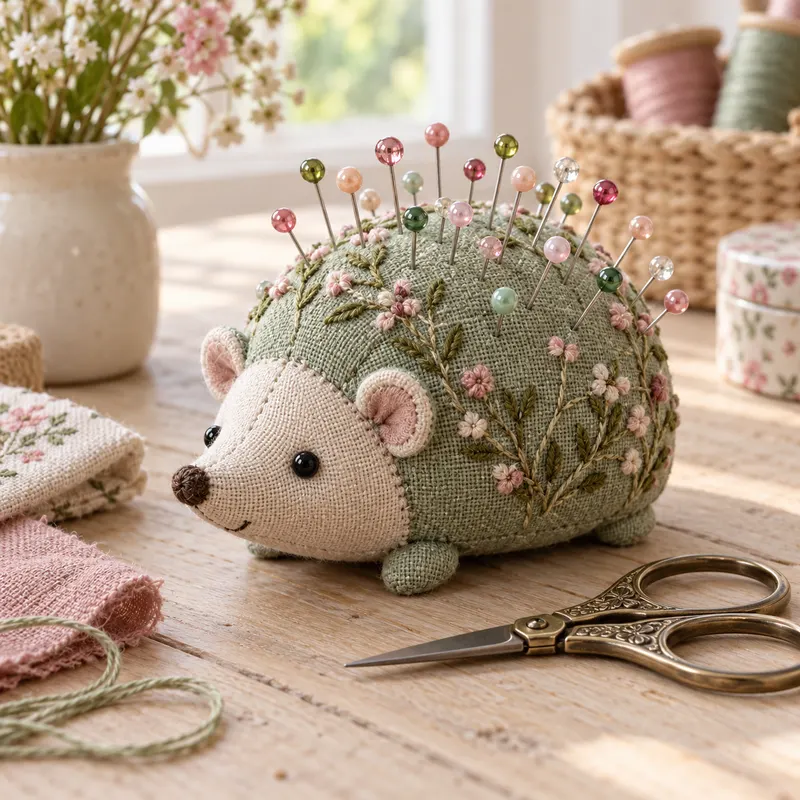
A small hedgehog pincushion sewn from linen and wool scraps, weighted so it sits still on the table and stuffed hard enough to grip pins.
Pinned up on
A pincushion is the perfect scrap project, because it has to be firm rather than soft. That changes two things compared with a toy: the fabric must be tightly woven so pins do not slip through and snag, and the filling must grip.
The hedgehog shape is a body of two side pieces and a base, with a pointed face sewn on as a separate panel. The finished size is about 12 cm long.
Step 1: Choose a fabric that pins well
You need
- linen or quilting cotton scraps
Linen and closely woven quilting cotton are ideal. Loose weaves such as cheesecloth let the filling creep out round each pin. Fleece and plush are too stretchy and the cushion loses its shape. Cut two side pieces and an oval base with a 6 mm seam allowance.
Step 2: Stitch the face panel to one side
You need
- face fabric
- machine or backstitch by hand
Sew the face fabric to the front end of each side piece, right sides together, before you join the body. The colour change gives the snout. Press the seam towards the body.
Step 3: Join the body and base
You need
- pins
- 2 mm stitch length
Sew the two sides together along the back and snout, then sew in the base, leaving a 5 cm opening along one side. Clip the curves at the nose to within 2 mm of the stitching and turn through.
Step 4: Weight it, then pack it hard
You need
- rice or pellets in a small cotton bag
- wool roving or walnut shell
Put the small weight bag in first and push it down onto the base. A pincushion that skates across the table every time you push in a pin is no use. Then pack the rest very firmly. Wool roving keeps a little lanolin, which helps pins slide in. Crushed walnut shell also works and keeps points sharp, but it is heavy and it is not for children’s toys.
Step 5: Close and stitch the face
You need
- ladder stitch thread
- black floss
Close the opening with ladder stitch. Make two French knot eyes and a satin stitch nose at the snout tip. A few lines of running stitch over the back look like spines before the pins arrive.
Leave it on the table for a week before you decide whether it is firm enough. If pins lean over, unpick 3 cm of the base seam and add more filling. A good pincushion feels almost solid.